
More extended unemployment benefits becoming available
Sacramento – Workers who’ve lost their jobs or had their hours reduced during this pandemic continue to collect unemployment benefits in large numbers. The California Employment Development Department (EDD) reports paying $3.5 billion in total benefits last week alone, far surpassing the highest one-week total of benefits paid during the Great Recession which was $542 million in February 2010. So far since the pandemic struck, the EDD has processed more than 6.7 million claims and paid a total of $33.5 billion in benefits between the state’s regular Unemployment Insurance (UI) program and the federal Pandemic Unemployment Assistance (PUA), and Pandemic Emergency Unemployment Compensation (PEUC) programs.
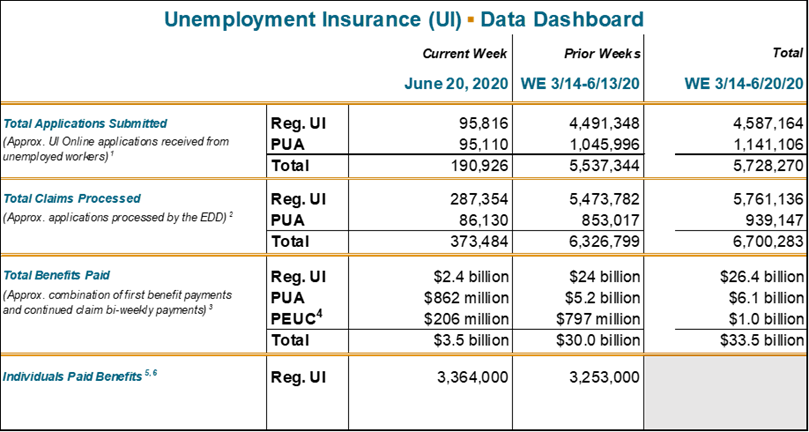
1. The Pandemic Unemployment Assistance (PUA) was implemented in California on April 28, 2020.This data includes initial claims only.
2. Claims processed through UI Online, along with about 5% of claims that arrive via paper or phone. This accounts for claims received in the current week as well as past weeks. The data also includes claims that are re-opened when there is a break in certifying for benefits, for example when the claimant may return to work but then later come back to collect benefits on their initial claim.
3. Includes $600 federal stimulus payments EDD adds to each week of regular UI/PUA/PEUC benefits. Regular UI benefits are paid out of California’s UI Trust Fund with contributions from employers, PUA, PEUC and the $600 federal stimulus payments are paid for by the federal government.
4. For the week ending June 13, 2020, Pandemic Emergency Unemployment Compensation (PEUC) total weeks claimed was 296,831PEUC claims are an extension of a regular UI claim.
5. Counts include individuals claiming regular UI or PEUC benefits. If an individual claims a regular UI benefit and a PEUC benefit in a four-week rolling time period, they are only counted once.
6. Four-week rolling totals accommodate for numerous variables that dictate what claimants receive benefits in any given bi-weekly period. Data excludes claimants were who fully employed, disqualified or had excessive earnings that would disqualify them for a week of benefits.
7. Four-week rolling total between week-ending May 30 and week-ending June 20, 2020.
8. Four-week rolling total between week-ending May 23 and week-ending June 13, 2020.
Additional Unemployment Insurance (UI) benefits soon available for long term unemployed
The EDD is finalizing the details of a separate extension of regular UI benefits that will soon become available for those who are struggling to return to a job in the midst of this coronavirus pandemic. The Federal-State Extended Duration benefits program, known in California as FED-ED, only becomes available during times of high or prolonged periods of unemployment. It will offer up to at least 13 weeks of additional benefits for those who run out of their initial benefits on their regular state UI claim, as well as any benefits they are eligible for on the current 13-week federal Pandemic Emergency Unemployment Compensation (PEUC) extension. The first week a claimant could be exhausting a current PEUC claim is next week. The EDD is sweeping our systems and will be automatically filing a new FED-ED claim for those potentially eligible. More details will become available next week.
EDD adds more staff as expedited hiring effort continues
The department is in the midst of a massive hiring effort with the goal of quickly filling more than 4,800 positions statewide over just a matter of weeks. To date, the EDD has hired almost 1,200 new staff to help bolster our ability to fully meet the historic demand for benefits created by the pandemic. Another 1,400 offers are being finalized, while about 500 others have conditional job offers as we await the results of background checks. The pandemic hit at a time of record low unemployment in California which meant low federal funding paying for low staffing levels. Fast forward a few months and an unprecedented 300% increase in the number of unemployed in California and the EDD is now receiving increased federal administrative funding to support the expedited hiring effort with the support of Cal HR. Anyone interested in positions available throughout the state should visit our Careers with EDD webpage.
Common pandemic-related confusion disrupts eligibility for ongoing benefit payments
The regular state UI, as well as federal Pandemic Unemployment Assistance (PUA) are both eligibility-based benefit programs. Workers who’ve lost a job or are working reduced hours through no fault of their own must certify their ongoing eligibility for benefits every two weeks before they can receive their next payment. This mandated bi-weekly process of answering basic eligibility questions is known as certifying.
While claimants receive helpful information about completing their certifications timely every two weeks, the EDD has found many common mistakes which can delay benefit payments unnecessarily as EDD staff must complete a manual review to determine if the individual is eligible for benefits.
The first question on the certification asks “Were you too sick or injured to work?”
You must be well enough to work every day of the week in order to receive unemployment benefits. But many are responding yes, they are too sick which disqualifies them from benefits for the week. During a follow up by EDD, they say they were not sick but they felt they needed to answer yes because COVID is still impacting the population. The EDD reminds claimants to avoid this delay and be sure to answer the question as it relates to your own health and availability to work.
The second question on the certification asks “Was there any reason (other than sickness or injury) that you could not have accepted full-time work each workday?”
You must be available for work to receive UI benefits. Available means you are ready and willing to accept work even though businesses may still be closed due to the pandemic. However, the EDD is finding that many claimants are again responding yes, believing they can’t accept work because of COVID.
When in actuality, they are or would be available for work when they are called upon by either their employer or a new job opportunity.
Not being available for work and willing to accept suitable work will disqualify you for benefits, unless your case meets good cause provisions for refusing work. Some examples include having no childcare as long as the individual explored all alternatives to obtain childcare (even asking for a different work schedule accommodation), or being over the age of 65 or having a serious health condition that meet high risk factors as identified by the state Department of Public Health. Visit EDD COVID FAQs for more information.
Other top reasons benefit payments can be delayed
- Missing other names used – On the initial application for unemployment benefits, claimants are asked to provide any other names they may have used in their employment history, including nicknames or maiden names. The EDD verifies identity information with the Social Security Administration and DMV. If we aren’t able to match the names with information provided by the claimant, the claim will have to be diverted to the manual identity verification process which will take additional time to confirm individuals are who they say they are. To avoid these delays, the EDD reminds claimants to ensure they provide names used for a Social Security Card or driver’s license on their application.
- EDD return calls – If a claimant encounters an eligibility issue on their initial application or bi-weekly certification for benefits, the EDD may have to schedule a determination interview with the claimant to collect more information. The individual will be notified of the date and time by mail and receive sample questions the interviewer may ask. The call may appear as restricted or blocked due to it coming from a government source. We strongly encourage claimants to be prepared to answer their phone during the time period identified to prevent processing delays. EDD representatives will identify themselves, will relay the specific reason the call is about, and will know the individual’s customer account number.